From Calisthenics to the Living Room: How Home Exercise Took Shape
Home exercise history traces how organised movement shifted among public grounds, indoor halls and domestic rooms, helping explain how a spare patch of floor became a place to practise.
The common mistake in home exercise history is to picture a single march from calisthenics drills to the living-room workout. The story is less tidy: people have used public grounds, organised indoor rooms and domestic spaces for movement, with different purposes and arrangements in each.
Public grounds and shared aims
Calisthenics, or ordered movements using the body’s own weight, could be practised by groups without each person needing specialised equipment. Schools, military settings, clubs and public grounds offered places where an instructor or group leader could organise movement.
Those settings did not all serve the same purpose. Exercise might be connected with education, discipline, recreation or preparation for work and service; the emphasis depended on the institution and the people involved. It is more accurate to see these as overlapping uses than as one universal story of why people exercised.
A shared space could provide instruction and company, but access depended on local arrangements: a person might need a school, club, class or suitable outdoor place. Public practice was visible and communal, not automatically open to everyone.
Indoor rooms for practice
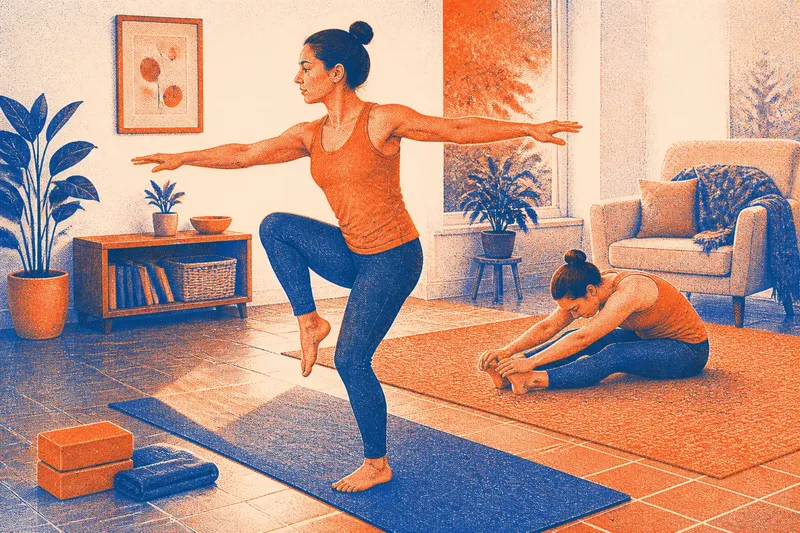
Some schools and organisations used halls or gymnasiums for physical activity. These rooms offered shelter and could accommodate group instruction; depending on the venue, equipment might include items such as bars or benches. A cleared hall could also host drills without being a purpose-built gym.
The setting shaped the session. A teacher, a printed sequence or a group’s shared rhythm could organise practice, while the room marked out a particular time and purpose for movement. Indoor exercise was therefore not simply a private version of activity outdoors.
This is a limited connection to today’s home workout, not proof that old gymnasiums directly produced it. Indoor venues made it possible to practise away from an open field, while domestic routines developed through their own mix of instruction, household space and available equipment.
Domestic exercise takes shape
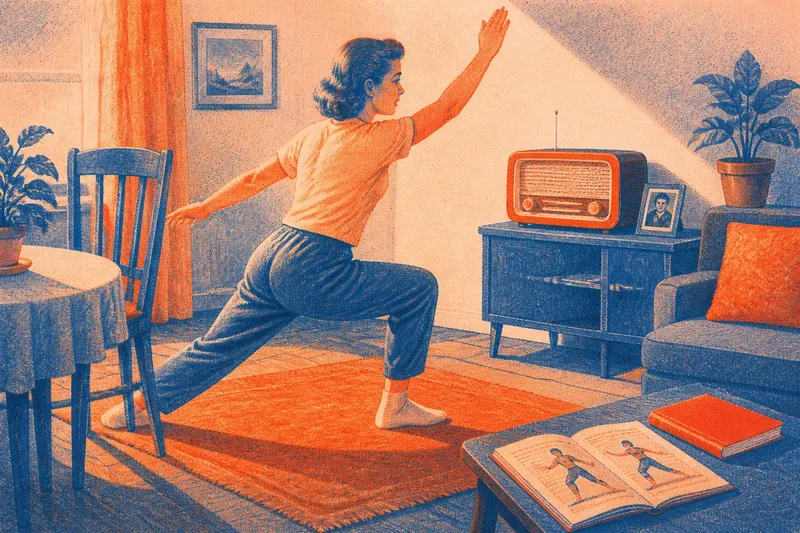
Home exercise did not begin with one invention. Printed advice and illustrated manuals could offer routines for readers to follow; radio and recorded programmes later provided other ways to hear or watch instruction. Compact equipment also appeared in some households, though a routine did not require it.
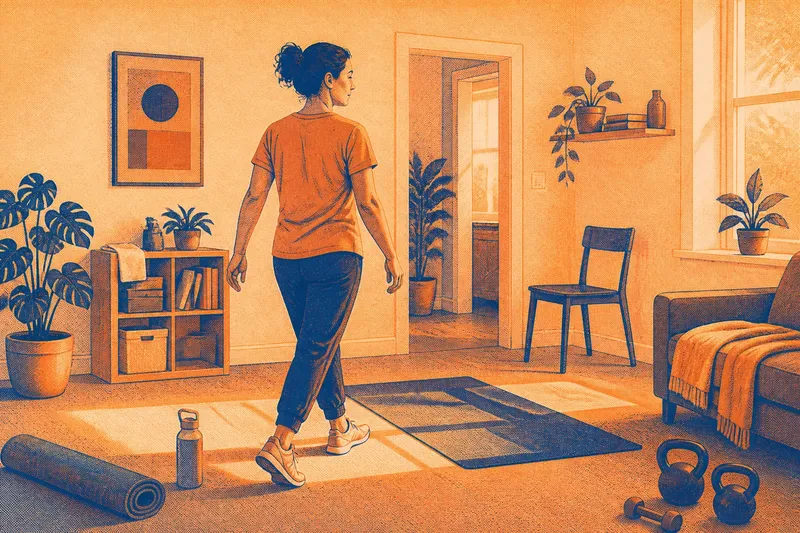
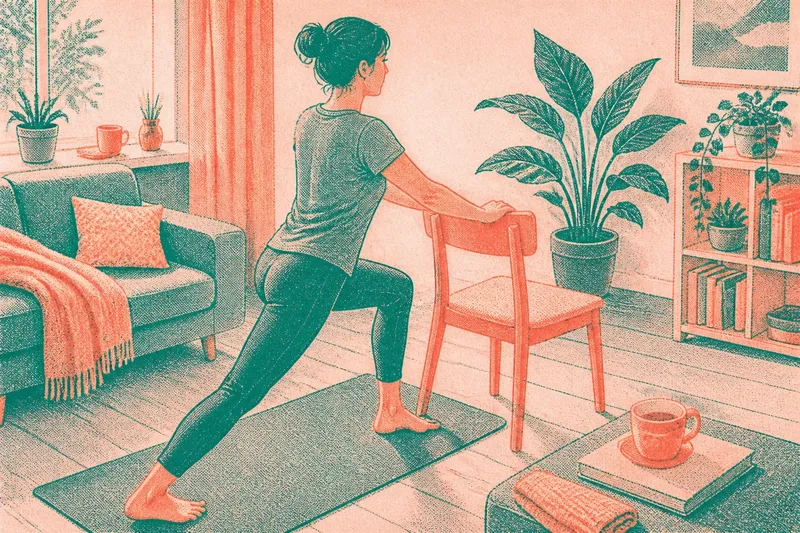
A domestic room brought different constraints. Someone might need to move a chair, make room around a table or pause when another household member needed the space. Practice could fit around daily responsibilities, but depended on a workable patch of floor and the household’s willingness to share it.
Say a household has a chair beside a narrow sitting-room rug and a radio programme to follow. They shift the chair against the wall, check that the route around the rug is clear, then use the open patch for a short sequence; afterwards, returning the chair restores the room’s usual layout. The visible result is a temporary exercise space, not a newly built gym.
What did the room change?
Moving exercise into a home changed how instruction and company could be arranged. A public class might offer a leader and other participants, while a page, radio programme or recording allowed a person to practise without a group present. Neither format suited everyone, and households combined them in different ways.
Layout mattered just as much as the source of instruction. A clear floor made some movements easier to arrange; crowded furniture, noise or other people’s needs could call for a smaller routine or a different time. The room’s ordinary uses remained part of the exercise plan.
It is not worth the effort to recreate an imagined historical gym at home. Collecting period-style equipment or copying old formations misses the more useful point: a household could adapt an existing room, briefly and practically, for movement.
How did home exercise develop?
Why did calisthenics suit groups?
Bodyweight movements could be taught to a group without a machine for each participant. A leader could use shared instructions and rhythms to organise a session, although the exact practice depended on the setting.
How did exercise enter indoor spaces?
Schools and other organisations could use halls or gymnasiums for sheltered group activity. Separately, printed and broadcast instruction offered ways to practise at home; these were distinct changes, not one direct handover from gym to living room.
Why use a living room for exercise?
A living room was already part of household life, so it could sometimes be adapted without creating a dedicated exercise room. Furniture and shared needs also meant that the space might have to be cleared and restored each time.
Did home routines replace public classes?
No single setting needs to be treated as a replacement for all the others. Parks, schools, clubs and indoor venues could offer group activity, while domestic practice provided another arrangement for movement.
A room made available
Home exercise history is best understood as a set of changing arrangements, rather than a straight line of invention. Group drills, indoor instruction and domestic routines each depended on different spaces and ways of organising practice.
The useful idea is simple: a room does not have to be permanently set aside for exercise to serve that purpose. If a clear patch can be made safely and fitted around the household, home exercise history has a familiar present-day echo in the ordinary space briefly opened for movement.